No War With Iran: A Movement, Not a Moment
March 30, 2026
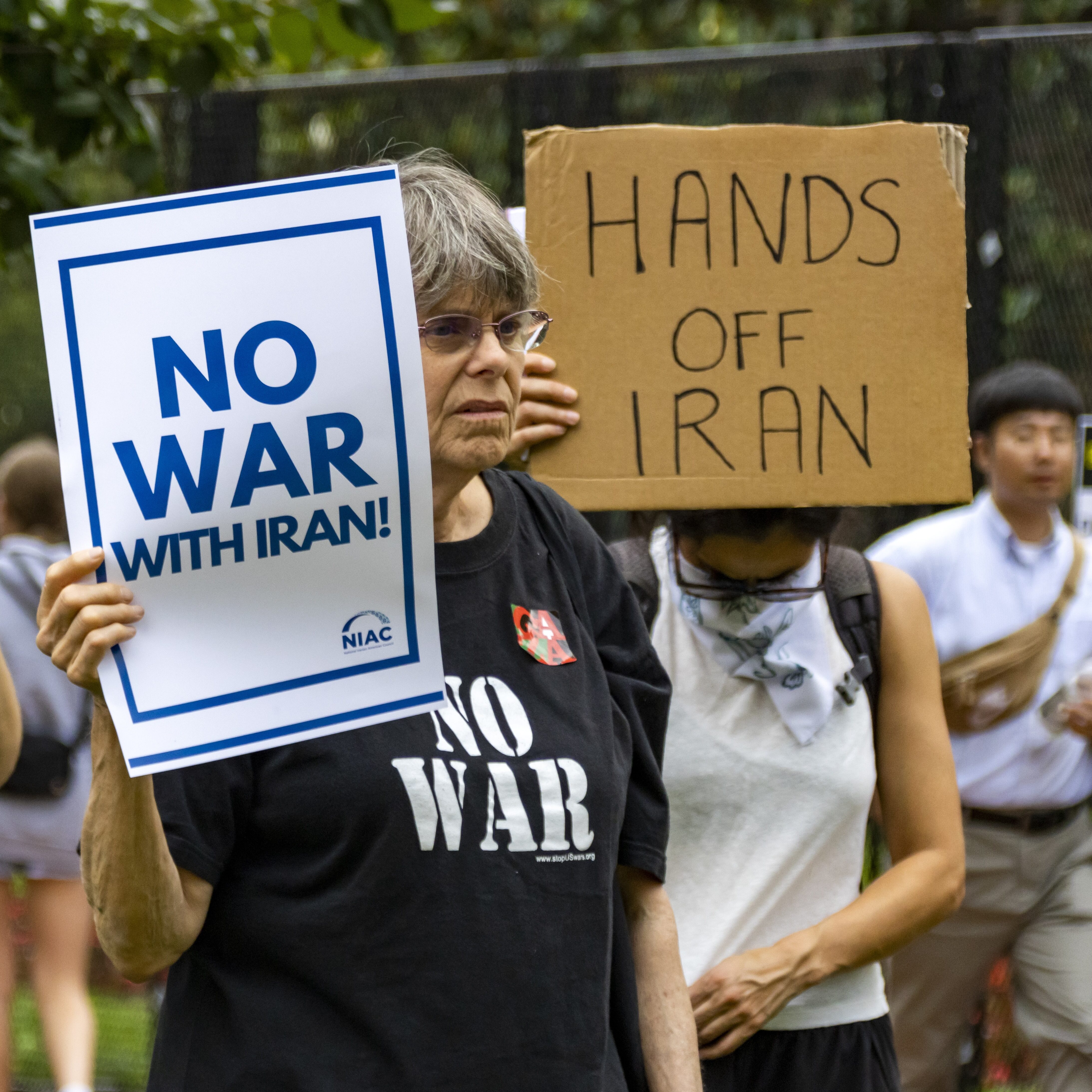
A month into the US and Israel war on Iran, a few clear patterns are emerging. Polling shows that the American public does not support the war. Members of Congress are publicly denouncing the war and advancing efforts to cut off funding. And countless experts, advocates, and organizers are driving home a key message: there is no military solution to Iran’s nuclear program.
These messages reflect the drumbeat of the nuclear threat reduction community, which has worked for decades towards a diplomatic solution to Iran’s nuclear program. While Trump has gone in circles about whether this war is even about Iran’s nuclear program, he has kept the door open to addressing the issue, going as far as saying such an effort could include US boots on the ground. Last week, President of Ploughshares, Dr. Emma Belcher, joined nuclear and scientific experts alongside former administration officials in an open letter clearly stating there is no military solution to Iran’s nuclear program—and this senseless, catastrophic war of choice only further proves the point.
In 2015, the nuclear threat reduction community celebrated the accomplishment of the Joint Comprehensive Plan of Action (JCPOA). This was a landmark, first-of-its-kind achievement between China, France, Germany, Russia, the United Kingdom and the United States, with the European Union and Iran. The JCPOA successfully capped Iran’s enrichment program, blocked Iran’s pathway to weaponization, and established intrusive and extensive monitoring mechanisms. It was the result of tireless diplomacy and coordinated advocacy to advance negotiations on the nuclear file, and it demonstrated that the only successful solution to nonproliferation is a diplomatic one.
Ploughshares was proud to support those whose work led to this achievement and to play our part to secure nonproliferation goals. But in 2018, President Trump unilaterally withdrew the US from the deal. He did this when Iran was operating in full compliance with the terms of the agreement.
Back then, President Trump argued he wanted to make room for a bigger, better deal. Instead, now in his second term as President, Trump has carried out two military conflicts with Iran and risks permanently closing the door for diplomatic success down the line.
In June 2025, while diplomatic talks on the nuclear file were underway, the US followed up Israel’s attacks against Iran with a slew of strikes on Iran’s nuclear facilities. These attacks severely damaged Iran’s nuclear sites. But, experts made it clear that Iran maintained the ability to reconstitute their nuclear capabilities, Iran’s highly enriched uranium was likely buried, and Iran’s nuclear knowledge remained intact. While these attacks hindered diplomatic progress for many months, negotiations resumed in early 2026. Then, at the end of February, while diplomatic efforts were reportedly making significant progress, Trump once again decided to attack Iran even though Iran’s nuclear program did not pose any imminent threat.
A Marist poll found that 56% of Americans opposed the war within the first week. According to a New York Times analysis, it is the least supported US military intervention in any conflict dating back to WWII. Recent polling also shows that as the war escalates, 58% of Trump voters don’t want to see US boots on the ground.
Ploughshares’ and our partners’ efforts over the years have paved the way for “no war with Iran” to be a common sense cause. Global security experts and activists are working to ensure that public understanding of this war remains rooted in data, facts, and sound historical analysis. Grassroots organizers are activating the American public to use their voice and tell their elected officials that this war must end. These efforts in turn are advancing direct pressure on Congress to stop this war through their tangible ability to prevent further funding for the conflict. Multiple War Powers Resolutions on the Hill have put every Member of Congress on the record on this illegal war. And, as the ongoing war will only put more American service members in harm’s way, political visibility is sure to elevate anti-war candidates during the upcoming US midterm elections.
Every angle of this work requires incredible coordination and sustained support, through grantmaking, and by connecting and convening partners to heighten their collective impact. Years of building trust between key partners allows those advancing peace and security to respond immediately and continuously to this crisis, creating a system of shared information, cohesion and movement. Ploughshares then acts to magnify their work and further compound their collective influence.
It is in the midst of this intense moment that Ploughshares continues to assess and adapt to ensure we can show up for the nuclear threat reduction community when it matters the most—but also that we are advancing new tools, creative ideas, and connections with those working across the peace and security space to shift policy decisions. Today, if you look around, the anti-war sentiments go far beyond the nuclear threat—those advocating for peace, security, human rights, humanitarian access, nonproliferation, and climate and energy security are all rising up, together, with a shared voice to end this war.
Ploughshares will continue to mobilize the nuclear threat reduction community in service of solutions for this moment, and we will simultaneously generate space to think long term about how we continue to advance the nonproliferation movement. No war with Iran is a cause that demonstrates how intertwined nuclear issues are with all elements of peace and security. We will ensure the lesson drawn from this war is not a growing appetite for nuclear weapons around the globe, but rather a recognition of the value of principled diplomacy and the costs borne by countless people when it is abandoned.